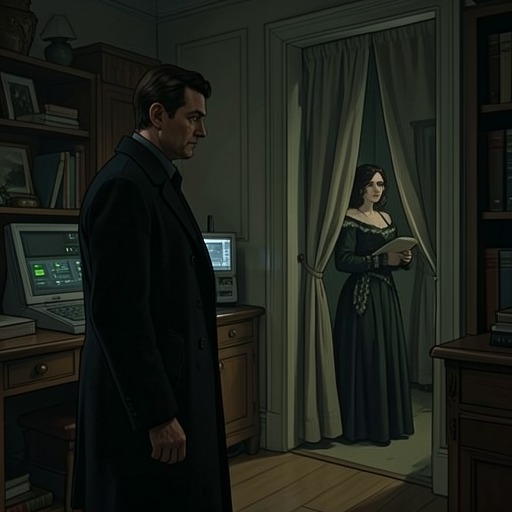
Desire and idealization
In Search of Lost TimeDesire and idealization is the narrator’s recurring tendency to experience a woman not simply as she appears, but through the expectations, circumstances, and imagined intimacy that gather around her. At Balbec, this process can turn an unremarkable girl into an object of longing, lend a meeting the promise of a fairy-tale encounter, and make the eventual person seem at odds with the image that desire had created. The ideal is not a fixed portrait: it shifts with the narrator’s mood, distance, memory, and hopes, revealing how romantic feeling can be powerful precisely because it is built from incomplete knowledge.
Perception and the shifting image
At Balbec, the narrator sometimes sees a girl on the beach and wonders whether she is the same person he had once longed to approach after seeing her emerge with friends from a riding school or gymnasium. The question cannot be settled by appearance alone. He suspects that the intoxicating girl he had imagined may never have existed as such, yet the beachgoers’ faces give him no stable evidence: they seem to contract or expand and change form according to his expectation, desire, and sense of well-being, as well as their clothes and whether they walk quickly or stand still. From close by, two or three nevertheless seem adorable. Desire does not merely judge a finished image; it helps produce the image it then takes for its object.
The narrator’s response to these girls is also shaped by place. He longs to take one along the Avenue des Tamaris, among the sandhills, or, best of all, to the cliff. The desired woman is thus imagined together with a scene of possible intimacy. Yet the route from longing to action remains uncertain: desire contains an impulse toward realization, but hesitation and shyness leave a broad vacancy between wanting to ask for a kiss and actually asking.
Circumstance, courage, and unequal desire
The narrator crosses that gap after drinking seven or eight glasses of port in the café-bar. Alcohol seems to join desire and action, dissolving his fear and making him feel that the girl is about to fly into his arms. He approaches and proposes a walk along the cliff, mentioning the shelter of a small wood and an empty wooden bungalow. The ease he experiences is not shared evidence of mutual desire. The obstacles have disappeared for him, but not for her, who has not been drinking; what feels to him like a dream suddenly made attainable may not be her dream at all. The scene makes the asymmetry of idealization concrete: his altered confidence transforms the encounter in his own eyes without establishing what the woman wants.
A related pattern appears in the narrator’s account of circumstance as a bait that can initiate love. Weather and the prospect of meeting a woman in an isolated farmhouse may be enough to make him rearrange his week to know someone who would otherwise scarcely attract his attention. He recognizes that these conditions do not truly belong to the woman, but they can still hook him. Under different circumstances—cold weather and a town—he imagines he might desire the same woman without falling in love. Once feeling has taken hold, however, it can be no less strong for having arisen through circumstance; with age, it becomes more melancholy as he recognizes how little room another person may occupy in a life and how finite even a hoped-for enduring love must be.
Letters, memory, and the imagined beloved
The narrator sometimes writes to women he scarcely knows, or has not seen for years, before meeting them. A reply that seems to promise love can bring intense joy, and he wants to keep the first letters close, returning to their phrases as if to rare flowers whose scent can be breathed again. He rereads what he remembers and checks expressions whose wording is less certain, searching a sentence for the degree of affection it might contain. Even a small misreading can briefly disturb the pleasure: “Your precious letter” turns out to have been “your previous letter.” The episode shows how the beloved is first encountered through language as well as through sight; a phrase may carry the emotional weight of a promise before the correspondent’s presence can confirm what it means.
The letters, however, do not settle the image. The narrator wants to place their written words beside the woman’s eyes and voice, so he arranges a meeting. He may expect a Fairy Queen from description or memory and find instead Puss-in-Boots. Yet the discrepancy does not necessarily end desire: he arranges another meeting for the following day, because the woman is still the person he had wanted. His longing does not require that each physical feature match the ideal in advance. The desired person can remain the same even when the anticipated appearance fails, since the expectation has been attached to her through a mixture of memory, correspondence, and imagined possibility.
Many desires, repeated disappointments
The narrator compares his desires for different women to perfumes associated with deities in the Orphic hymns. Styrax, saffron, spices, myrrh, manna, and incense suggest distinct, elusive qualities, but each perfume belongs to more than one deity, and the list of divine associations proliferates. The analogy makes desire at once particular and transferable: a certain atmosphere or longing may feel like the essence of one imagined beloved, yet it can also attach to others. The desires, the narrator observes, are fewer than the girls themselves; they recur in forms that lead to closely similar disappointments and regrets.
That recurrence is not simply the repetition of one ideal woman. The narrator distinguishes among longings while acknowledging that the same kind of longing can migrate from one object to another. He reserves myrrh for Jupien and the Princesse de Guermantes, a specific exception within the broader series of changing desires. The passage therefore turns the catalogue of perfumes into an account of how imagination both differentiates and reuses its materials: desire gives each attraction an aura, but the aura may be more durable than the encounter that first seemed to justify it.
Narrative significance
Desire and idealization is presented as a problem of knowledge as much as a force of attraction. The narrator can observe faces, reread letters, remember earlier impressions, and propose a meeting, yet none of these gives him direct access to the woman’s experience. His perception alters with expectation and circumstance; his confidence after drinking does not establish reciprocity; and the language of a letter can be misread even when it is read repeatedly. Each attempt to approach the beloved therefore encounters the gap between an inward image and another person who cannot be reduced to it.
The pattern also explains why disappointment need not extinguish longing. The imagined figure can fail to match the woman encountered, while the desire remains attached to her and sends the narrator toward another meeting. Across beach encounters, written exchanges, and remembered fantasies, idealization is less a single error corrected by reality than a continuing activity through which the narrator makes people desirable. The people themselves remain partly unknown; the narrative’s sharpest evidence concerns the changing forms of his expectation, and the recurrent distance between what he hopes to find and what another person can be presumed to want.